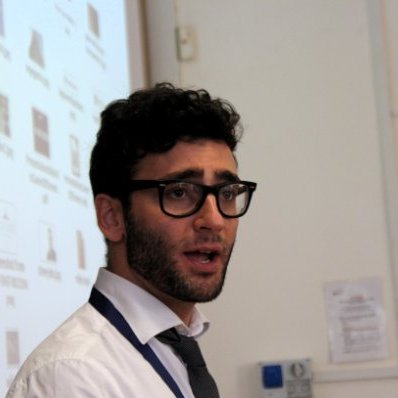
Ludovico Ferranti
Ph.D. in Electrical and Computer Engineering, 2020
Education
- Ph.D. (double degree) - Northeastern University and Sapienza University of Rome (2020)
- M.S. in Artificial Intelligence and Robotics - Sapienza University of Rome, Italy (2015, 110/110)
Ludovico Ferranti received his Ph.D. from both Northeastern University and Sapienza - University of Rome in 2020. He earned his Master of Science in Engineering in Artificial Intelligence and Robotics (110/110) from Sapienza - University of Rome in 2015. His research interests include micro and nanorobotics, biomedical devices, UAV aerial networks, robotics swarms algorithms, and wireless sensor networks. He was advised by Prof. Francesca Cuomo and Prof. Tommaso Melodia. His work on HIRO-NET received the Best Paper Award at IEEE WoWMoM 2019.
Publications
2022
Journals & Magazines
This article describes HIRO-NET, an Heterogeneous Intelligent Robotic Network. HIRO-NET is an emergency infrastructure-less network that aims to address the problem of providing connectivity in the immediate aftermath of a natural disaster, where no cellular or wide area network is operational and no Internet access is available. HIRO-NET establishes a two-tier wireless mesh network where the Lower Tier connects nearby survivors in a self-organized mesh via Bluetooth Low Energy (BLE) and the Upper Tier creates long-range VHF links between autonomous robots exploring the disaster-stricken area. HIRO-NET's main goal is to enable users in the disaster area to exchange text messages to share critical information and request help from first responders. The mesh network discovery problem is analyzed and a network protocol specifically designed to facilitate the exploration process is presented. We show how HIRO-NET robots successfully discover, bridge and interconnect local mesh networks. Results show that the Lower Tier always reaches network convergence and the Upper Tier can virtually extend HIRO-NET functionalities to the range of a small metropolitan area. In the event of an Internet connection still being available to some user, HIRO-NET is able to opportunistically share and provide access to low data-rate services (e.g., Twitter, Gmail) to the whole network. Results suggest that a temporary emergency network to cover a metropolitan area can be created in tens of minutes.
2020
Conference Papers
In this paper we propose SkyCell, a prototyping platform for 5G autonomous aerial base stations. While the majority of work on the topic focuses on theoretical and rarely implemented solutions, SkyCell practically demonstrates the feasibility of an aerial base station where wireless backhaul, autonomous mobility and 5G functionalities are integrated within a unified framework. We showcase the advantages of Unmanned Aerial Vehicles for 5G applications, discuss the design challenges, and ultimately propose a prototyping framework to develop aerial cellular base stations. Experimental results demonstrate that SkyCell not only supports heterogeneous data traffic demand and services, but also enables the implementation of autonomous flight control algorithms while improving metrics such as network throughput (up to 35%) and user fairness (up to 39%).
Networks of Unmanned Aerial Vehicles (UAVs), composed of hundreds, possibly thousands of highly mobile and wirelessly connected flying drones will play a vital role in future Internet of Things (IoT) and 5G networks. However, how to control UAV networks in an automated and scalable fashion in distributed, interference-prone, and potentially adversarial environments is still an open research problem. This article introduces SwarmControl, a new software-defined control framework for UAV wireless networks based on distributed optimization principles. In essence, SwarmControl provides the Network Operator (NO) with a unified centralized abstraction of the networking and flight control functionalities. High-level control directives are then automatically decomposed and converted into distributed network control actions that are executed through programmable software-radio protocol stacks. SwarmControl (i) constructs a network control problem representation of the directives of the NO; (ii) decomposes it into a set of distributed sub-problems; and (iii) automatically generates numerical solution algorithms to be executed at individual UAVs.We present a prototype of an SDR-based, fully reconfigurable UAV network platform that implements the proposed control framework, based on which we assess the effectiveness and flexibility of SwarmControl with extensive flight experiments. Results indicate that the SwarmControl framework enables swift reconfiguration of the network control functionalities, and it can achieve an average throughput gain of 159% compared to the state-of-the-art solutions.
2019
Conference Papers
In this paper we present HIRO-NET, Heterogeneous Intelligent Robotic Network. HIRO-NET is an emergency infrastructure-less network tailored to address the problem of providing connectivity in the immediate aftermath of a natural disaster, where no cellular or wide area network is operational and no Internet access is available. HIRO-NET establishes a two-tier wireless mesh network where the Lower Tier connects nearby survivors in a self-organized mesh via Bluetooth Low Energy (BLE)and the Upper Tier creates long-range VHF links between autonomous robots exploring the disaster stricken area. HIRO-NET main goal is to enable users in the disaster to exchange text messages in order to share critical information and request help from first responders. The mesh network discovery problem is analyzed and a network protocol specifically designed to facilitate the exploration process is presented. We show how HIRO-NET robots successfully discover, bridge and interconnect local mesh networks. Results show that the Lower Tier always reaches network convergence and the Upper Tier can virtually extend HIRO-NET functionalities to the range of a small metropolitan area. In the event of an Internet connection still being available to some user, HIRO-NET is able to opportunistically share and provide access to low data-rate services (e.g. Twitter, Gmail)to the whole network. Results suggest that a temporary emergency network to cover a metropolitan area can be created in tens of minutes.
This paper investigates the advantages and design challenges of leveraging Unmanned Aerial Vehicles (UAVs) to deploy 4G/5G femto- and pico-cells to provide quality-aware user service and improve network performance. In order to do so, we combine UAVs dashing flight capabilities with Software-defined Radios (SDRs) flexibility and devise the concept of self-optimizing UAV Base Stations (UABSs). The proposed framework allows for on-the-fly drone repositioning based on rigorous optimization techniques using real-time network metrics to enhance users' service. This makes it possible to offload the traditional cellular infrastructure, or to mend its temporary failure, by deploying UABSs in areas of interest. Cellular connectivity is, then, provided to mobile subscribers through the LTE-compliant OpenAirInterface software interfaced with the on-drone SDR. We first describe the UABS design challenges and approaches. Then, we give details on the devised optimization algorithm and its main requirements. Finally, we illustrate a prototype implementation of the proposed UABS that leverages an SDR device and a PX4 flight controller, and test its effectiveness. Experimental results demonstrate that UABSs are able to autonomously reposition themselves based on cellular network metrics and to improve network performance.
“Quality Aware Aerial-to-Ground 5G.”
Proc. of IEEE Global Communications Conference (GLOBECOM)
(2019)Conference
2017
Journals & Magazines
Conference Papers
“UAVs deployment in Heterogeneous Networks: enhancing video streaming QoE.”
First Intl. Balkan conference on Communications and Networking (BalkanCom)
(2017)Conference
2015
Conference Papers
“Nano-wireless Communication for Microrobotics: bridging the gap.”
Proceedings of the Second Annual International Conference on Nanoscale Computing and Communication
(2015)Conference