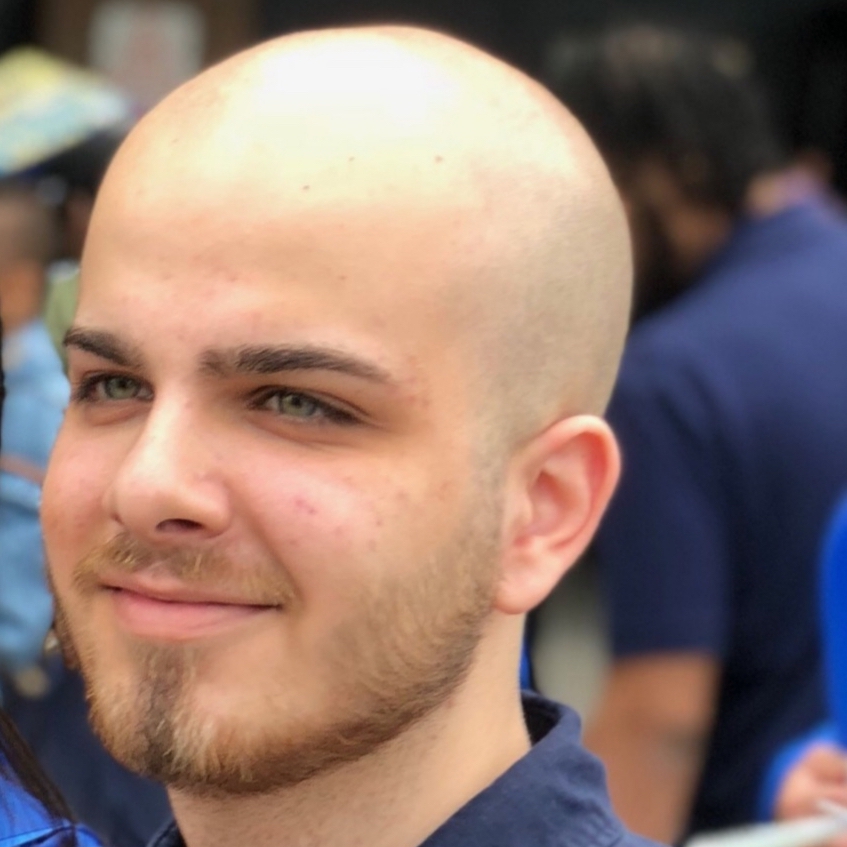
Daniel Uvaydov

Ph.D. in Electrical Engineering, 2023

Education

  • Ph.D. in Electrical Engineering - Northeastern University (2023)
  • B.S. in Electrical Engineering - University at Buffalo, SUNY (2018)

Research Interests

Daniel Uvaydov earned his Ph.D. in Electrical Engineering from Northeastern University in 2023. He obtained his B.S. in Electrical Engineering from the University at Buffalo (UB), The State University of New York in May 2018. At UB, he was under the advisement of Professor Josep M. Jornet, with whom he also did research on intra-body optical communications and 5G communications testbeds. At Northeastern University, he was a research assistant in the WiNES lab under the advisement of Professor Tommaso Melodia. His research interests included intra-body wireless networks, embedded deep learning for the Internet of Things and Internet of Medical-Things, and deep learning for wireless communications. After graduation, he joined Qualcomm as a Modem Systems Engineer.

Publications

In this paper, we introduce SeizNet, a closed-loop system for predicting epileptic seizures through the use of Deep Learning (DL) method and implantable sensor networks. While pharmacological treatment is effective for some epilepsy patients (with ~65M people affected worldwide), one out of three suffer from drug-resistant epilepsy. To alleviate the impact of seizure, predictive systems have been developed that can notify such patients of an impending seizure, allowing them to take precautionary measures. SeizNet leverages DL techniques and combines data from multiple recordings, specifically intracranial electroencephalogram (iEEG) and electrocardiogram (ECG) sensors, that can significantly improve the specificity of seizure prediction while preserving very high levels of sensitivity. SeizNet DL algorithms are designed for efficient real-time execution at the edge, minimizing data privacy concerns, data transmission overhead, and power inefficiencies associated with cloud-based solutions. Our results indicate that SeizNet outperforms traditional single-modality and non-personalized prediction systems in all metrics, achieving up to 99% accuracy in predicting seizure, offering a promising new avenue in refractory epilepsy treatment.

Link

The ever-growing number of wireless communication devices and technologies demands spectrum-sharing techniques. Effective coexistence management is crucial to avoid harmful interference, especially with critical systems like nautical and aerial radars in which incumbent radios operate missioncritical communication links. In this demo, we showcase a framework that leverages Colosseum, the world’s largest wireless network emulator with hardware-in-the-loop, as a playground to study commercial radar waveforms coexisting with a cellular network in CBRS band in complex environments. We create an ad-hoc high-fidelity spectrum-sharing scenario for this purpose. We deploy a cellular network to collect IQ samples with the aim of training an ML agent that runs at the base station. The agent has the goal of detecting incumbent radar transmissions and vacating the cellular bandwidth to avoid interfering with the radar operations. Our experiment results show an average detection accuracy of 88%, with an average detection time of 137 ms.

Link

Because of the ever-growing amount of wireless consumers, spectrum-sharing techniques have been increasingly common in the wireless ecosystem, with the main goal of avoiding harmful interference to coexisting communication systems. This is even more important when considering systems, such as nautical and aerial fleet radars, in which incumbent radios operate mission-critical communication links. To study, develop, and validate these solutions, adequate platforms, such as the Colosseum wireless network emulator, are key as they enable experimentation with spectrum-sharing heterogeneous radio technologies in controlled environments. In this work, we demonstrate how Colosseum can be used to twin commercial radio waveforms to evaluate the coexistence of such technologies in complex wireless propagation environments. To this aim, we create a high-fidelity spectrum-sharing scenario on Colosseum to evaluate the impact of twinned commercial radar waveforms on a cellular network operating in the CBRS band. Then, we leverage IQ samples collected on the testbed to train a machine learning agent that runs at the base station to detect the presence of incumbent radar transmissions and vacate the bandwidth to avoid causing them harmful interference. Our results show an average detection accuracy of 88%, with accuracy above 90% in SNR regimes above 0 dB and SINR regimes above --20 dB, and with an average detection time of 137 ms.

Link